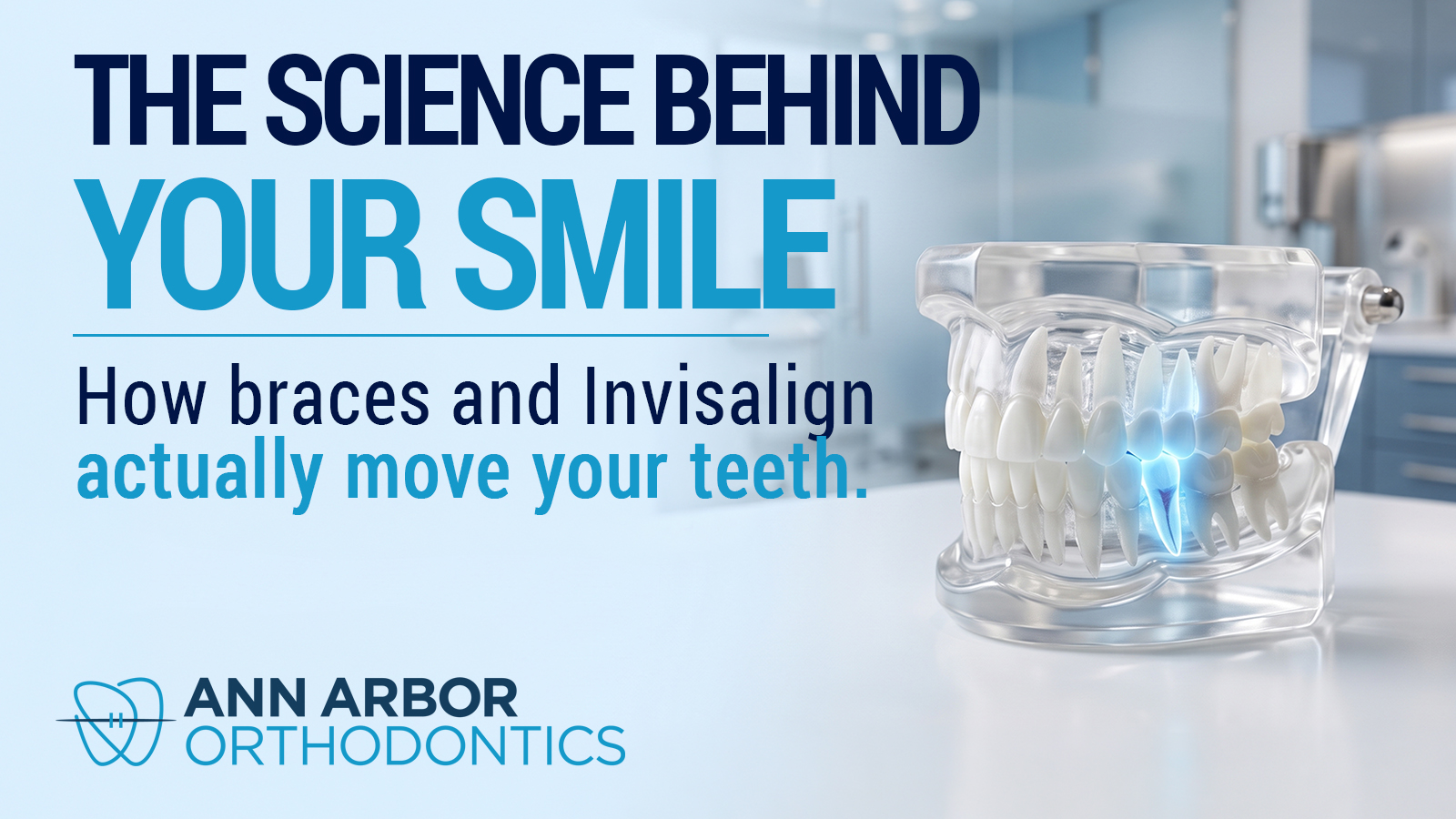
It's one of the most common questions we get from patients: how do braces or Invisalign actually move your teeth? It might seem like magic, but it's actually biology — a carefully orchestrated process happening inside your jaw every single day of treatment.
At Ann Arbor Orthodontics, we think understanding this process helps patients stay motivated and patient throughout treatment. Once you know what's really going on beneath the surface, those months of wearing braces or aligners start to make a lot more sense.
Your teeth aren't rigidly fused to your jawbone. Instead, each tooth is suspended by a network of fibers called the periodontal ligament, which allows for small, controlled movement. This ligament is the key to how orthodontic treatment works at all.
.png)
When braces or Invisalign apply gentle, consistent pressure to a tooth, that pressure compresses the periodontal ligament on one side and stretches it on the other. This triggers a natural biological response:
This process is called bone remodeling, and it's the same biological mechanism your body uses to heal and adapt throughout life — orthodontic treatment simply guides it in a specific direction.
2.png)
Tooth movement isn't continuous. It typically happens in phases: an initial phase where the tooth responds quickly to new pressure, a lag phase where the surrounding tissue reorganizes itself, and a longer phase where steady movement continues. This is exactly why regular adjustments or new aligner trays — usually every 4 to 8 weeks — are so important. Each one restarts the process in a new direction, keeping your treatment plan on track.
Whether you're wearing traditional braces or Invisalign, the underlying biology is identical. Braces use brackets and archwires to apply constant directional pressure, while Invisalign uses a series of custom aligners that each move your teeth in small, calculated increments. Both methods rely on the same bone remodeling process — they just apply the pressure differently.
.png)
Depending on what your smile needs, your orthodontist may guide your teeth through several distinct types of movement, including tipping the crown of a tooth, moving a tooth's root and crown together in one direction, rotating a tooth along its axis, or adjusting how deep a tooth sits in the gum line. Each type requires a different amount of force and time, which is part of why every treatment plan looks a little different.
Yes — and now you know why. That mild tenderness after an adjustment is simply your body responding to the remodeling process. It's a sign that things are working as they should, and it typically fades within a few days.
Understanding the biology behind tooth movement doesn't just satisfy curiosity — it can make treatment feel a lot less mysterious. Every adjustment, every new aligner, and every checkup is a deliberate step guided by your Comprehensive Treatment plan. If you're curious about what your own treatment timeline might look like, the best next step is a complimentary evaluation, where we can map out exactly what your smile needs.
